

Updated September 2026
The Alberta Energy Regulator (AER) provides for the safe, efficient, orderly, and environmentally responsible development of hydrocarbon, geothermal, and mineral resources over their entire life cycle. As part of our mandate, we provide our stakeholders with credible statistical reports about Alberta’s energy and mineral resources that can be used for decision making.
A key statistical report is the Alberta Energy Outlook (ST98), our annual report that provides independent and concise information and data on the state of hydrocarbon reserves, and supply and demand outlooks for Alberta’s diverse energy resources, including crude bitumen, crude oil, natural gas, natural gas liquids, coal, and emerging resources. Following last year’s partial release, the reserves data in this report has been fully updated to reflect the main findings of the complete external report by McDaniel & Associates. In addition, the ST98 report includes information and data on prices, capital expenditures, pipelines, carbon capture, utilization, and storage (CCUS), and other infrastructure related to Alberta's energy and mineral resources.
The outlooks presented in this report reflect the best available information at the time of publication, including current geopolitical situations and pipeline announcements. Subsequent developments are not captured in this report and may cause actual outcomes to deviate from these projections.
For more information on the Alberta Energy Outlook, please view the AER’s Annual Report in the Appendix, page 47. The report highlights infographic [PDF] is available for download in PDF format.
Disclaimer: This Statistical Report is provided for informational purposes only. The AER makes no representations or warranties, express or implied, regarding the accuracy, completeness, currency, or fitness for any particular purpose or use of the data and all such warranties are expressly disclaimed. The AER is not liable for any direct, indirect, or consequential damages arising from the use of the data, and is not responsible for any costs incurred relating to the conversion, installations, or improvement of AER data files by the AER or user. By accessing or using this data, users confirm that they have read, understood, and agree to be bound by the terms of this disclaimer in addition to the general disclaimer on the AER's page.
Additional Information
Terminology
A | B | C | D | E | F | G | H | L | M | N | O | P | R | S | T | U | W |
A
Alberta Energy Company’s storage hub (AECO-C)
The AECO-C hub is a virtual trading point that sets the main pricing index for Albertan and Canadian natural gas.
AECO-C Price
The Natural Gas Exchange (NGX) volume-weighted average of transacted prices for all physically delivered natural gas in a calendar month; at the Alberta Nova Inventory Transfer (ABNIT) market centre.
API gravity
A specific gravity scale developed by the American Petroleum Institute (API) for measuring the relative density or viscosity of various petroleum liquids.
apportionment
When shippers desire to ship more oil or oil products in a given month than the pipeline can transport, shipper volumes are apportioned (reduced) based on the tariff in effect. Apportionment can be caused by factors such as growing supply, increased demand, pipeline reconfigurations, reduced pipeline capacity, or refinery maintenance.
B
Brent Blend (Brent)
A grade of light sweet crude oil derived from a mix of 15 different oil fields in the North Sea. Brent blend futures are traded on the Intercontinental Exchange Inc. (ICE) and are considered a global benchmark for oil prices.
brownfield
Brownfield projects are projects built where land has previously been developed or where there is room to expand an existing facility.
butane
In addition to its normal scientific meaning, a mixture mainly of butanes that ordinarily may contain some propane or pentanes plus (Oil and Gas Conservation Act, section 1(1)(j)).
C
capital costs
Expenditures by a company to build, purchase, or upgrade physical assets such as land, equipment, and processing facilities.
carbon capture, utilization, and storage (CCUS)
A range of technologies and processes that capture carbon dioxide from industrial sources or directly from the atmosphere, and then utilized by injecting it into underground porous formations as part of CO2-enhanced oil recovery or used to produce manufactured goods.
carbon capture and storage (CCS)
A process similar to CCUS but excludes the utilization of carbon dioxide and instead it is injected into subsurface formations (e.g., saline aquifers or depleted oil and gas reservoirs) for permanent storage.
clean coal
Clean coal is coal that has been processed for export by washing raw coal to remove soil and rock sediment. While subbituminous coal is burned without any form of upgrading, both metallurgical and thermal bituminous coal are sent in raw form to a preparation plant to be processed into clean coal. On average, about 65% of raw metallurgical bituminous coal and less than 50% of raw thermal bituminous coal is recovered as clean coal in Alberta. Subbituminous raw coal and both types of clean bituminous coal are collectively known as marketable coal.
coal
A combustible sedimentary rock that contains at least 50% by weight organic matter formed from plant or algal matter (Coal Conservation Act, section 1(1)(d)).
coalbed methane (CBM)
Naturally occurring dry gas, predominantly methane, produced during the transformation of organic matter into coal.
cogeneration
The use of natural gas used to simultaneously generate electricity and thermal energy (such as steam or heat) for use in extraction, refining or other operations.
condensate
A mixture mainly of pentanes and heavier hydrocarbons that may be contaminated with sulphur compounds, that
- is recovered or is recoverable at a well from an underground reservoir and may be gaseous in its virgin reservoir state but is liquid at the conditions under which its volume is measured or estimated, or
- is recovered from an in situ coal scheme and is liquid at the conditions under which its volume is measured or estimated (Oil and Gas Conservation Act, section 1(1)(k)).
crude bitumen
A naturally occurring viscous mixture, mainly of hydrocarbons heavier than pentane, which may contain sulphur compounds and that, in its naturally occurring viscous state, will not flow to a well (Oil Sands Conservation Act, section 1(1)(c)).
crude oil (conventional)
A mixture mainly of pentanes and heavier hydrocarbons that may be contaminated with sulphur compounds, that is recovered or is recoverable at a well from an underground reservoir and that is liquid at the conditions under which its volume is measured or estimated, and includes all other hydrocarbon mixtures so recovered or recoverable except raw gas, condensate, or crude bitumen (Oil and Gas Conservation Act, section 1(1)(o)).
crude oil (heavy)
Crude oil with a density greater than or equal to 900 kg/m3 and less than 925 kg/m3 and is produced outside designated oil sands areas.
crude oil (light)
Crude oil with a density of 850 kg/m3 or less.
crude oil (light-medium)
Crude oil with a density less than 900 kg/m3.
crude oil (medium)
Crude oil with a density equal to 850 kg/m3 and less than 900 kg/m3.
crude oil (ultra-heavy)
Crude oil with a density of 925 kg/m3 or greater, produced outside designated oil sands areas.
crude oil (synthetic)
A mixture mainly of pentanes and heavier hydrocarbons that may contain sulphur compounds and is derived from crude bitumen and that is liquid at the conditions under which its volume is measured or estimated and includes all other hydrocarbon mixtures so derived (Oil and Gas Conservation Act, section 1(1)(zz)).
cyclic steam stimulation (CSS)
A technique that produces bitumen by injecting steam into underground oil sands reservoirs (i.e., wells) to heat bitumen, separate it from the sand, and allow it to flow to the well and be produced.
D
debottleneck
An engineering optimization process conducted by a company to improve efficiencies, reduce constraints limiting output at a facility, or both.
decline rate
The annual rate of decline in well productivity.
density
The mass or amount of matter per unit volume.
density, relative (raw gas)
The density relative to air of raw gas upon discovery, determined by an analysis of a gas sample representative of a pool under atmospheric conditions.
diluent
Lighter-viscosity petroleum products that are used to dilute crude bitumen for transport in pipelines.
E
enhanced recovery/development
The increased recovery from a pool achieved by artificial means or by the application of energy extrinsic to the pool, which artificial means or application includes pressuring, cycling, pressure maintenance or injection to the pool of a substance or form of energy, but does not include the injection in a well of a substance or form of energy for the sole purpose of
- aiding in the lifting of fluids in the well, or
- stimulation of the reservoir at or near the well by mechanical, chemical, thermal, or explosive means (Oil and Gas Conservation Act, section 1(1)(r)).
ethane
In addition to its normal scientific meaning, a mixture mainly of ethane that ordinarily may contain some methane or propane (Oil and Gas Conservation Act, section 1(1)(s)).
extraction
The process of liberating hydrocarbons (e.g., propane, bitumen) from their source (e.g., raw gas, mined oil sands).
F
feedstock
A raw material supplied to a refinery, oil sands upgrader, or petrochemical plant.
field (gas) plant
A natural gas facility that processes raw gas and produces a marketable product that meets pipeline specifications. These plants, located near the gas source, remove impurities, such as water and hydrogen sulphide, from the raw gas stream and may also extract natural gas liquids. See also NGL recovery (extraction plant).
formation
A rock unit with comparable lithology, facies, or other similar properties that allows geologists to map, describe, and name it. The primary unit of lithostratigraphy. Two or more formations can be packaged together into a group and formations can be subdivided into members.
fractionation plant
See NGL recovery (fractionation plant).
G
gas
Raw gas, synthetic coal gas or marketable gas or any constituent of raw gas, synthetic coal gas, condensate, crude bitumen or crude oil that is recovered in processing and that is gaseous at the conditions under which its volume is measured or estimated (Oil and Gas Conservation Act, section 1(1)(y)).
gas (associated)
Gas in a free state in communication in a reservoir with crude oil under initial reservoir conditions.
gas (dry)
Raw or processed gas that contains little to no natural gas liquids.
gas (liquefied petroleum gas)
Mixes containing butanes and propane are referred to as liquefied petroleum gas (LPG) and are used primarily as fuel sources for cooking and heating appliances and for vehicles.
gas (liquids-rich)
Raw gas that contains a relatively high concentration of natural gas liquids.
gas (marketable)
A mixture mainly of methane originating from raw gas, if necessary through the processing of the raw gas for the removal or partial removal of some constituents, and that meets specifications for use as a domestic, commercial or industrial fuel or as an industrial raw material (Oil and Gas Conservation Act, section 1(1)(ee)). Marketable gas is measured at standard conditions of 101.325 kPa and 15°C.
gas (nonassociated)
Gas that is not in communication in a reservoir with an accumulation of liquid hydrocarbons at initial reservoir conditions.
gas (raw)
A mixture containing methane, other paraffinic hydrocarbons, nitrogen, carbon dioxide, hydrogen sulphide, helium and minor impurities, or some of them, that is recovered or is recoverable at a well from an underground reservoir and is gaseous at the conditions under which its volume is measured or estimated (Oil and Gas Conservation Act, section 1(1)(tt)).
gas (solution)
Gas that is dissolved in crude oil under reservoir conditions and evolves as a result of pressure and temperature changes.
gas (sour)
Natural gas that contains measureable amounts of hydrogen sulphide (H2S). For this report, measurable refers to volumes of H2S in excess of 0.01%.
gas (wet)
Raw or processed gas that contains natural gas liquids.
gas-oil ratio (initial solution)
The volume of gas (in cubic metres, measured under standard conditions) contained in one stock-tank cubic metre of oil under initial reservoir conditions.
greenfield
Greenfield projects are projects built on land that has not previously been used and has no existing components or structures.
H
Henry Hub
A distribution hub on a main natural gas pipeline system in the United States near Erath, Louisiana. It is the pricing point for natural gas futures contracts traded on the New York Mercantile Exchange (NYMEX).
horizontal well
A well in which the lower part of the wellbore is drilled parallel to the zone of interest.
hydraulic fracturing
Hydraulic fracturing is the process of pumping fluid into a wellbore to create enough pressure to crack, or fracture, the rock layer. The fluid usually contains a “proppant,” like sand, that helps keep the fractures open to allow oil and gas to be produced to the well.
hydraulic multistage fracturing
The application of hydraulic fracturing over multiple segments within a well leg, starting at the “toe,” or near-end point of the drilling leg, and moving backwards to the “heel,” or vertical portion of the well leg. This drilling and completion technique is commonly used to access low-permeability reservoirs. It significantly improves production because the wellbore is able to access a greater length of the reservoir.
L
liquefied natural gas (LNG)
Natural gas that has been converted to liquid form at deep freezing temperatures for storage and overseas transportation.
M
marketable bitumen
Upgraded and nonupgraded bitumen available to be used as refinery feedstock.
methane
In addition to its normal scientific meaning, a mixture mainly of methane that ordinarily may contain some ethane, nitrogen, helium, or carbon dioxide (Oil and Gas Conservation Act, section 1(1)(ff)).
multilateral well
A well where two or more production holes, usually horizontal in direction with reference to the zone of interest, are drilled from a single surface location.
N
natural gas
See gas.
natural gas liquids (NGLs)
Ethane, propane, butanes, pentanes plus, or a combination of these, obtained from the processing of raw gas or condensate.
netback
An economic indicator of profitability expressed as a dollar value per unit of production after subtracting key costs such as transportation, processing, and marketing. It is usually measured per barrel of oil equivalent.
NGL recovery (deep-cut gas facility)
A natural gas processing facility capable of extracting ethane and other natural gas liquids.
NGL recovery (extraction plant)
A natural gas processing facility that can remove natural gas liquids from raw or processed natural gas. Extraction plants can remove an NGL mix but cannot split the natural gas liquids into separate components. See also field (gas) plant.
NGL recovery (fractionation plant)
A natural gas processing facility that takes a natural gas liquids stream and separates out its different components: ethane, propane, butane, and pentanes plus.
NGL recovery (shallow-cut gas facility)
A natural gas processing facility that extracts propane, butane, and pentanes plus.
NGL recovery (straddle plant)
A reprocessing plant on major natural gas transmission lines near Alberta’s borders that extracts natural gas liquids (NGLs) from marketable gas. Most plants are deep-cut facilities that then ship an NGL stream to fractionation plants in central Alberta.
nonupgraded bitumen
Nonupgraded bitumen refers to crude bitumen that is blended with a lighter-viscosity product (referred to as a diluent) to meet specifications for transport through pipelines.
O
off-gas
Natural gas produced from upgrading bitumen. This gas is typically rich in natural gas liquids and olefins.
oil
Condensate, crude oil, or synthetic coal liquid or a constituent of raw gas, condensate, or crude oil that is recovered in processing, that is liquid at the conditions under which its volume is measured or estimated (Oil and Gas Conservation Act, section 1(1)(hh)).
oil sands
- sands and other rock materials containing crude bitumen,
- the crude bitumen contained in those sands and other rock materials, and
- any other mineral substances, other than natural gas, in association with that crude bitumen or those sands and other rock materials referred to in subclauses (i) and (ii) (Oil Sands Conservation Act, section 1(1)(l)).
oil sands areas
For administrative purposes, the geological formations and the geographic areas in Alberta that contain bitumen are designated as oil sands areas. There are three oil sands areas in Alberta: Athabasca, Cold Lake, and Peace River.
oil sands deposit
A natural reservoir containing or appearing to contain an accumulation of oil sands separated or appearing to be separated from any other such accumulation (Oil and Gas Conservation Act, section 1(1)(jj)).
operating costs
Includes both fixed and variable costs associated with running a project on a day-to-day basis.
P
pentanes plus
A mixture mainly of pentanes and heavier hydrocarbons that ordinarily may contain some butanes and that is obtained from the processing of raw gas, condensate or crude oil (Oil and Gas Conservation Act, section 1(1)(mm)).
play
A geological play can be defined as a set of known or estimated oil or gas accumulations (pools and deposits) within a petroleum system that share similar geological, geographic, and temporal properties, such as a source rock, migration pathways, timing, trapping mechanism, and hydrocarbon type.
pool
- a natural underground reservoir containing or appearing to contain an accumulation of oil or gas, or both, separated or appearing to be separated from any other such accumulation, or
- in respect of an in situ coal scheme, that portion of a coal deposit that has been or is intended to be converted to synthetic coal gas or synthetic coal liquid (Oil and Gas Conservation Act, section 1(1)(oo)).
pressure (initial)
The reservoir pressure at the reference elevation of a pool upon discovery.
probable reserves
Additional reserves that are less certain to be recovered than proved reserves. It is equally likely (P50) that the actual remaining quantities recovered will be more or less than the sum of the estimated proved and probable reserves.
propane
In addition to its normal scientific meaning, a mixture mainly of propane that ordinarily may contain some ethane or butanes (Oil and Gas Conservation Act, section 1(1)(rr)).
proved reserves
Those reserves that can be estimated with a high degree of certainty to be recoverable. It is likely (at least a 90% probability) that the actual remaining quantities recovered will exceed the estimated proved reserves.
R
recovery (enhanced)
See enhanced recovery.
refined petroleum products
End products in the refining process.
refinery light ends
Light oil products produced at a refinery; includes gasoline and aviation fuel.
refinery utilization
Refinery utilization shows the ratio of throughput to capacity.
removals
Product that has been removed from Alberta.
reprocessing facilities
Gas processing plants used to extract ethane and natural gas liquids from marketable natural gas. Such facilities, also referred to as straddle plants, are located on major natural gas transmission lines.
reserves
Estimates of remaining quantities of petroleum anticipated to be recoverable from known accumulations as of a given date, using technology that is known, either currently available or in use, and commercially possible.
reservoir
Reservoirs are any subsurface rocks that are able to store fluids (water, oil, and gas) inside their pores or fractures.
resources
Quantities of petroleum estimated to exist originally in naturally occurring accumulations, including all known and estimated quantities yet-to-be discovered.
S
sales gas
A volume of gas sold over a period of time. This gas may be augmented with gas from storage.
sequestration
The act or activity of injecting a fluid (such as carbon dioxide) into a subsurface porous formation and permanently trapping the fluid.
shale
The AER uses the criteria published in Bulletin 2010-28: Zones Eligible for Shale Gas Fluid Codes. As a general guide, a mudstone/shale succession may be defined as being one or more of the following:
- a laminated rock with greater than 67% clay-sized minerals, often with fissility.
- a blocky or massive fine grained sedimentary rock in which the proportion of clay is approximately equal to or greater than silt-sized particles.
- a fine grained, low permeability clastic, carbonate, or mixed-lithology rock of which the exact composition is unknown; however, on a geophysical log, the response of the production interval is uniformly shaley.
shale gas
The naturally occurring gas produced from organic-rich, fine-grained rocks.
shale NGLs
The naturally occurring mixture of natural gas liquids produced from organic-rich, fine-grained rocks.
shale oil
A naturally occurring mixture of mainly pentanes and heavier hydrocarbons produced from organic-rich, fine-grained rocks.
shrinkage factor (initial)
The volume occupied by one cubic metre of oil from a pool measured at standard conditions after flash gas liberation consistent with the surface separation process and divided by the volume occupied by the same oil and gas at the pressure and temperature of a pool upon discovery.
solvent
A suitable mixture of hydrocarbons ranging from methane to pentanes plus but consisting largely of methane, ethane, propane, and butanes for use in enhanced-recovery operations.
specification product
A crude oil or refined petroleum product with defined properties.
Station 2
Station 2 is the trading point located at the physical intersection of many of the gas outputs from northern B.C. gas wells and processing plants.
steam-assisted gravity drainage (SAGD)
A method of in situ recovery where steam is injected into a horizontal well to heat the bitumen in a reservoir and allow it to flow; gravity pulls the heated bitumen to a second horizontal well positioned below the first and the bitumen is then produced to the surface.
steam-assisted gravity drainage (SAGD) well pad
A well pad made up of multiple pairs of wells, each pair has one well for high-pressure steam injection (injector), and one for the production of oil (producer).
straddle plant
See NGL recovery (straddle plant).
successful wells drilled
Wells drilled for gas or oil that are cased and not abandoned at the time of drilling.
sulphur
Sulphur is a chemical element commonly found in conventional natural gas, crude bitumen, crude oil, and coal.
synthetic crude oil (SCO)
T
takeaway capacity
Takeaway capacity is the total capacity for moving crude oil out of Alberta, via pipeline, rail, and truck.
tight gas
Tight gas is gas trapped in the pores and fractures of low-permeability rocks. Producing tight gas requires extra stimulation, such as hydraulic fracturing.
tight oil
Tight oil is crude oil trapped in the pores and fractures of low-permeability rocks and is generally liquid under reservoir conditions. Producing tight oil requires extra stimulation, such as hydraulic fracturing.
U
unit train
Unit trains, or block trains, are freight trains in which all cars are carrying the same type of commodity, all bound for the same destination. In this way, unit cars do not need to stop at different junctions for each commodity and can make single, nonstop runs.
upgraded bitumen
A mixture of hydrocarbons, similar to crude oil, derived by upgrading bitumen from oil sands. Generally considered to be equivalent to synthetic crude oil (SCO) but can also include refined petroleum products.
upgrading
A process that converts bitumen and heavy crude oil into a mixture of lighter hydrocarbons by removing carbon or adding hydrogen.
W
well
A hole drilled in the earth for the purpose of finding or producing natural gas or crude oil.
wells placed on production
Wells that have been physically connected to gathering infrastructure and are reporting production; includes newly drilled wells that have been placed on production and recompletions into new zones of existing wells.
working gas storage
The amount of natural gas that can be injected into the storage and withdrawn at a later moment in time to meet demand.
Western Canadian Select (WCS)
A grade of heavy crude oil derived from of a mix of heavy crude oil and crude bitumen blended with diluents. The price of WCS is often used as a representative price for Canadian heavy crude oils.
West Texas Intermediate (WTI)
A light sweet crude oil that is typically referenced for pricing at Cushing, Oklahoma.
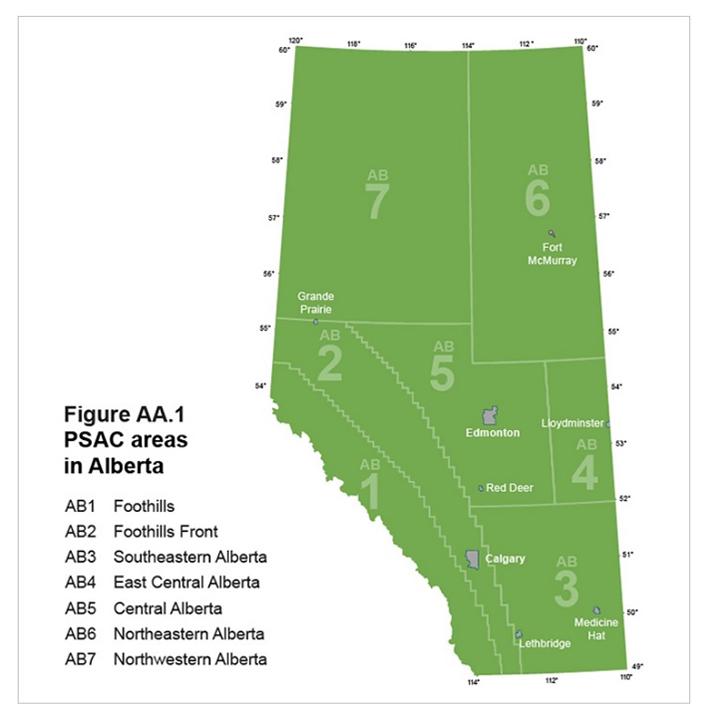
The Petroleum Services Association of Canada (PSAC) has sectioned Canada into a number of geographic regions based on the predominate type of geological interest to the oil and gas industry. Figure AA.1 shows the PSAC areas in Alberta. The AER often refers to the historical, current, and future oil and gas activity it discusses by PSAC area.
For additional archived files, please contact InformationRequest@aer.ca.
| Year | Summary | Infographic | Data |
|---|---|---|---|
| 2025 | ZIP | ||
| 2024 | ZIP* | ||
| 2023 | ZIP* | ||
| 2022 | ZIP* | ||
| 2021 | ZIP* | ||
| 2020 | ZIP* | ||
| 2019 | ZIP* | ||
| 2018 | ZIP* | ||
| 2017 | ZIP* | ||
| 2016 | ZIP* |
* Zip file includes all datasets and Appendix E: Shapefiles and GeoTIFFs
** Data sets, shapefiles, and GeoTIFFs for this report (.XLSX, SHP, TIFF files ) - Data sets note: Each data series contains three parts. The first part is a .tif file to be used for presentations, however not all .tif files such as maps have corresponding data. The second part is an interactive graph based on the data series depicted in the third part. Shapefiles: The polylines for Appendix E maps are in a shapefile format which are designed to be viewed using any geographic information system tool. GeoTIFFs: Contains geographic data that position the image in the correct location in the world, and can be viewed in any geographic information system software. Only available for Appendix E maps.
Contact Us
For questions or concerns about this report, please contact our Customer Care Centre. For additional archived files, please contact InformationRequest@aer.ca.
