
November 2026
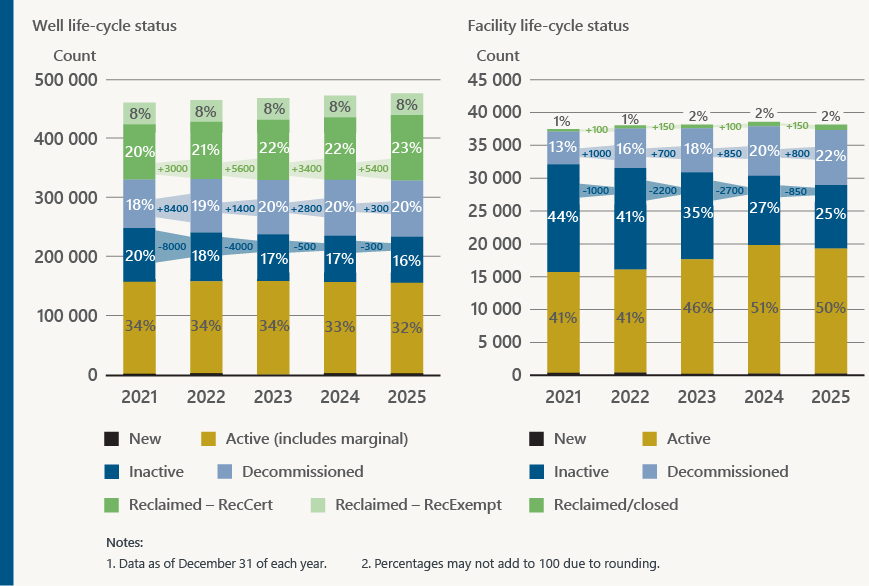
Well and facility life-cycle statuses change each year. New infrastructure is added or reactivated, and closure activity is completed by industry and the OWA. In 2025, the number of wells that received a reclamation certification increased compared to 2024 and was similar to the number in 2023. The overall inactive well population decreased slightly because some infrastructure was decommissioned, some moved from active to inactive, and others were reactivated (inactive to active).
The AER initiated a facility life-cycle project starting in January 2024 to improve industry-reported data and better assign life-cycle statuses for facilities. This project resulted in licences for facilities that were never constructed being cancelled and data validation that changed the life-cycle status of several facilities from inactive to active.
Figure 16. Change in life-cycle status, 2021–2025
Total industry liability estimates change every year. Liability is added with new activity, just as it is reduced through closure work. There is not a one-to-one linkage between closure spend and the reduction of liability. A $750 million industry closure quota does not result in a $750 million decrease in the total industry liability estimate. There are three reasons why there is not a one-to-one linkage.
The first reason is that the Inventory Reduction program accepts spend to be reported for closure activities that are not assigned a liability estimate. Examples of this include pipeline abandonment and well remediation. The AER accepts closure spend reported for these activities to gather costs so it can be used to update cost parameters in Directive 011.
The second contributor is that in some areas the estimated costs have not been updated, and therefore the liability estimated could be lower that the actual cost. An example of this would be the estimated well reclamation costs. The licensee and OWA reporting of closure spend for these closure activities has provided the AER sufficient data to review the estimated costs for these activities which is occurring in 2026.
The third reason there is not a one-to-one linkage is that the liability estimate only decreases once a closure activity is completed (e.g., after decommissioning work is complete and submitted or after a reclamation certificate is issued). Closure work is progressive. That is, the licensee is working towards the completion of an activity, but the activity is not always achieved within a reporting year (e.g., to achieve a reclamation certificate, local vegetation sometimes takes several seasons to re-establish).
Table 3 displays the spend for closure work in progress and the spend for sites that completed a closure activity. Remediation and reclamation activities take longer to complete; therefore, most of this spend is on sites that have yet to reach completion and are still in progress.
Licensees with a licensee quota of $50 000 or less can choose to pay a security deposit in lieu of meeting their licensee quota. This option provides flexibility for licensees where it can be difficult for them to complete meaningful closure activity every year.
As previously discussed, when a closure activity is completed, the liability estimate is reduced by the value from the most recent edition of Directive 011 or the SSLA, not the amount actually spent.
- Figure 14 shows that 6240 wells, facilities were decommissioned in 2025, while table 3 shows $292.8 million spent on completing decommissioning. However, this results in a liability estimate reduction of $379 million based on liability values in Directive 011 and the SSLAs. For the $229.9 million spend on decommissioning activities that was not completed in 2025, it did not result in a reduction in the liability estimate.
- Figure 15 shows that 4636 wells and facilities received a reclamation certificate, while table 3 shows $8.3 million spent on completing reclamation activities in 2025, which took numerous years; however, this results in liability estimate reduction of $107 million in 2025. The $162.2 million spend on reclamation activities that did not reach completion did not result in a reduction in the liability estimate in 2025
Table 3. Industry closure spend breakdown, 2022–2025
| Year | Closure in progress Spend ($ millions) | Closure milestone Spend ($ millions) | ||||
|---|---|---|---|---|---|---|
| Decommissioning | Environmental site assessment | Remediation | Reclamation | Decommissioning | Reclamation certified | |
| 2022 | 161.1 | 62.4 | 144.2 | 251.8 | 419.2 | 5 |
| 2023 | 178.9 | 45.7 | 175.3 | 179.8 | 339.6 | 2 |
| 2024 | 209.1 | 38.9 | 178.8 | 157.8 | 308 | 7.5 |
| 2025 | 229.9 | 26.4 | 192.5 | 162.2 | 292.8 | 8.3 |
Note: Data as of September 2026.
Licensee Quota Compliance
Each licensee with inactive liability has a licensee quota that needs to be met. Licensees that met the requirement spent equal to or more than their licensee quota or provided security in lieu of closure work. Licensees that did not meet the quota or provide security are noncompliant.
As of September 2026, 80% of licensees were compliant either through completing closure work or providing security for the 2025 program year. There are 96 noncompliant, active licensees with $22.8 million in outstanding quotas, which is 3% of the industry closure quota. The amount of outstanding security increased in 2025 as a result of revisions to Manual 023 that changed the definition of licensees that were active versus insolvent, moving more licensees to the category of active. For a complete list of active licensees with their assigned quota please refer to the company compliance with 2025 closure quota.
Table 4 summarizes the amount still owing in security for 2022–2025. The first column is the amount of outstanding security at a specific point in time from historical performance reports (September 30 of the following year). The second column shows the current outstanding security for each program year as of September 30, 2026. The AER continues to pursue compliance actions on an ongoing basis and licensees can continue to come into compliance from all years of the program either by reporting closure spend or providing security. For the 2025 program year the AER has collected $2.52 million in security with $22.80 million still outstanding.
More information can be found on the interactive licensee dashboard where stakeholders can review individual licensee information.
Table 4: Outstanding licensee quota compliance and security owing, 2022–2025
| Year | Outstanding Closure Security Owed ($ millions)* | Security still owning ($ millions)† |
|---|---|---|
| 2022 | 3.40 | 1.52 |
| 2023 | 5.00 | 3.62 |
| 2024 | 6.40 | 4.93 |
| 2025 | 22.80 | 22.80 |
* From previous performance reports, as of September 30 of the following year.
† Based on data received as of October 2026.
Licensee-specific compliance actions (i.e., limited eligibility, global refer status, issuance of an order) can be found on the AER Compliance Dashboard.
Table 5 lists the 17 active licensees who were noncompliant in relation to their licensee quotas for 2023, 2024, and 2025.
Table 5: Active Licensees noncompliant with 2023, 2024, and 2025 licensee quota
| Licensee name | Total security owed |
|---|---|
| 1099477 Alberta Ltd. | $3 878 |
| Bay Trail Resources Ltd. | $8 441 |
| Bluestone Resources Inc. | $47 103 |
| Frank O'Sullivan Petroleum Western Ltd. | $5 315 |
| Glen Isle Exploration Ltd. | $6 630 |
| Kasten Energy Inc. | $1 742 986 |
| Mass Resources Ltd. | $7 292 |
| Mooncor Energy Inc. | $94 944 |
| Mutiny Oil & Gas Ltd. | $188 641 |
| Pantera Silver Corp. | $3 878 |
| Petebrook Investments Ltd. | $7 755 |
| Renergy Petroleum (Canada) Co., Ltd. | $1 121 422 |
| Ridgeway Petroleum Corp. | $7 990 |
| Sunshine Oilsands Ltd. | $579 651 |
| Topeka Energy Inc. | $6 405 |
| True North Oil & Gas Limited | $6 405 |
See “Additional Information” on the Liability Management Performance Report webpage for the following:
- Interactive dashboards for licensee-specific information and regional-specific information. Only active licensees are included in this year’s report.
- A list of companies and their compliance with 2025 closure quotas. Only licensees with inactive liability from inactive or abandoned well or facility licences receive closure quotas.
Licensee compliance with the orphan fund levy can be found on the LM Reporting webpage.
