
Updated September 2026
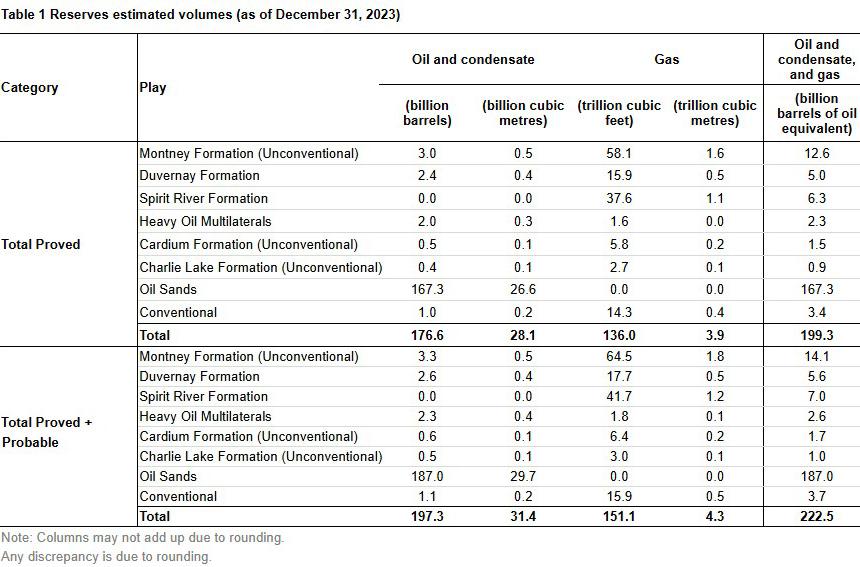
In 2024, the Alberta Energy Regulator (AER) procured the services of McDaniel and Associates Consultants Ltd. (McDaniel) to evaluate the reserves and resources of Alberta using industry-accepted methods published in the Canadian Oil and Gas Evaluation Handbook (COGEH) for conventional, unconventional, and oil sands formations. The new assessments differ from previous assessments conducted by the AER in that they include additional formations and apply updated standards and methods. Collaboration with McDaniel has supported a broader understanding of the province’s resource endowment and informed refining of our approach for future assessments. Unconventional reserves and resources in the Montney Formation, Duvernay Formation, Spirit River Formation, and regions of the Clearwater Formation developed with multilateral well designs were released in last year’s AEO report 2025 (Table 1). Assessments of the oil sands regions, Cardium Formation, Charlie Lake Formation, and conventional production for crude oil and gas have now been completed, shown in the table below.
As previously reported, the updated natural gas assessments for the Montney, Duvernay, and Spirit River formations are significant not only for Alberta but also for Canada. With new estimates for these formations, Canada has more than doubled its gas reserves, moving from 15th to 9th globally in reserves.
The use of multilateral wells for development of heavy oil in the Clearwater Formation and other parts of the Mannville Group has resulted in notable production growth over the past five years and has further contributed to the provincial oil reserves.
Reserves Terminology and Methodology
The McDaniel study focused primarily on a detailed evaluation of Alberta’s reserves. The province’s diverse resource base was grouped into six major resource plays, the oil sands (thermal and mining), and conventional production. The resource plays include the Montney Formation, Duvernay Formation, Spirit River Formation, heavy oil multilaterals (dominated by production from the Clearwater Formation), the Cardium Formation, and Charlie Lake Formation. The evaluations incorporate effectively 100% of the provincial oil and gas production and were completed using publicly available data.
The reserves terminology used in the Alberta Energy Outlook follows the Canadian Institute of Mining Standing Committee on Reserves Definitions, as presented in COGEH, meeting the requirement of being commercial, economic, discovered, and producible with established technology. For undeveloped reserves, appropriate analogue producing properties were used. The following reserves definitions are used in this report:
Proved Reserves – Those reserves that can be estimated with a high degree of certainty to be recoverable. It is likely (at least a 90% probability) that the actual remaining quantities recovered will exceed the estimated proved reserves.
Probable Reserves – Additional reserves that are less certain to be recovered than proved reserves. It is equally likely (P50) that the actual remaining quantities recovered will be more or less than the sum of the estimated proved and probable reserves.
The abbreviations used in this section include total proved (TP) and total proved + probable (TPP) reserves. Note that when comparing results presented in different tables, small discrepancies in the numbers are attributed to rounding differences.
The reserves are effective December 31, 2023, and, in accordance with COGEH, use the January 1, 2024, three-consultant average price deck prepared by McDaniel, GLJ Ltd., and Sproule ERCE.
The Government of Alberta has invested significant capital in developing the provincial petroleum resources through infrastructure and other components. Given that this capital expenditure has already taken place and that the reserves are reported at the Government of Alberta level, development-timing constraints that may apply to an exploration and development company are not considered applicable. This approach is consistent with section 5.2.3 of COGEH regarding government resource management, which notes that projects evaluated by governments may differ in the geographic area and geological unit of interest from those of a company and may reflect a broader overview of other factors. Consequently, the results of the McDaniel study may not be directly comparable to those reserves reported by individual companies developing the same geological interval or resource play.
Reserves Evaluations
Montney Formation
The Triassic Montney Formation contains both conventional and unconventional resource plays. To be consistent with the stratigraphic nomenclature used in British Columbia, the Montney Formation in Alberta was evaluated together with the Lower Doig Siltstone (Table 1). Unconventional TPP gas reserves in the Montney were assessed at 64.5 trillion cubic feet (Tcf), oil at 0.41 billion barrels (Bbbl) and condensate at 2.9 Bbbl. These reserves can be summarized as 14.1 billion barrels of oil equivalent (BOE). Reserves associated with conventional production from the Montney are aggregated with other formations in the Conventional Crude Oil and Natural Gas section and are not included in these estimates.
Duvernay Formation
The Devonian Duvernay Formation contains only unconventional resources (Table 1). TPP gas reserves in the Duvernay were assessed at 17.7 Tcf, oil at 1.74 Bbbl, and condensate at 0.89 Bbbl. These reserves can be summarized as 5.57 billion BOE.
Spirit River Formation
The Cretaceous Spirit River Formation contains significant natural gas resources from its Wilrich, Falher, and Notikewan members (Table 1). TPP natural gas reserves were assessed at 41.7 Tcf, or 7.0 billion BOE.
Heavy Oil Multilaterals
Multilateral wells use a novel drilling technology where a single wellbore drilled from the surface splits at depth into multiple horizontal legs. An array of horizontal leg trajectories (often between 7 and 12 legs, with an average leg length of about 1700 metres) increases reservoir exposure and can be executed at costs lower than drilling multiple standalone wells. Between 2017 and 2025, multilateral production in Alberta increased from about 30 000 to 230 000 barrels per day (bbl/d), with McDaniel concluding that it represents Canada’s fastest-growing oil resource play. Most activity occurred in the Clearwater Formation, although the Bluesky Formation and other intervals in the Upper Mannville Group are also being developed using multilateral technology. TPP reserves (Table 1) were assessed at 2.26 Bbbl of oil and 1.83 Tcf of natural gas, or 2.56 billion BOE.
Cardium Formation
The Upper Cretaceous Cardium Formation has been under development since the 1960s and experienced renewed activity with the application of modern horizontal drilling and hydraulic fracturing. TPP reserves are assessed at 587 million barrels (MMbbl) of oil and condensate and 6.44 Tcf of natural gas.
Charlie Lake Formation
The Triassic Charlie Lake Formation, composed of carbonate and evaporite deposits, contains both conventional and unconventional resource plays. The TPP reserves are estimated at 492 MMbbl of oil and condensate and 2.96 Tcf of gas.
Oil Sands Regions
Alberta’s oil sands contain more than 1.8 trillion bbl of bitumen (ST98 2015) and are found in the Cold Lake (Clearwater Formation and Grand Rapids Formation), Athabasca (McMurray Formation, Wabiskaw Member of the Clearwater Formation, and Grand Rapids Formation), and Peace River (Bluesky Formation) oil sands regions. Bitumen is produced in situ using steam-assisted gravity drainage (SAGD) or cyclic-steam stimulation (CSS) methods. SAGD output has more than tripled since 2010, reaching 1.6 MMbbl/d in December 2023. In the Athabasca region, where some of the oil sand deposits are too shallow for in situ methods, surface mining is used to recover the oil sand. There are currently eight mines and together they averaged 1.6 MMbbl/d of bitumen production in 2023, peaking at 1.8 MMbbl/d.
In situ TPP reserves were assessed at 153 Bbbl, and the combined in situ and mineable bitumen TPP reserves were assessed at 187 Bbbl. For mineable deposits, reserves were assigned for all producing and undeveloped mine pits that are assumed to be economic based on current data.
Conventional Crude Oil and Natural Gas
Undeveloped locations were not assessed for conventional oil and natural gas reserves. Only producing wells were assessed, with TPP oil assessed at 1.08 Bbbl and natural gas at 15.9 Tcf, or 3.73 billion BOE.
